Wallet Integration with Access Control Systems
Digital credentials only create value when they are connected to the systems that already manage identity and access.
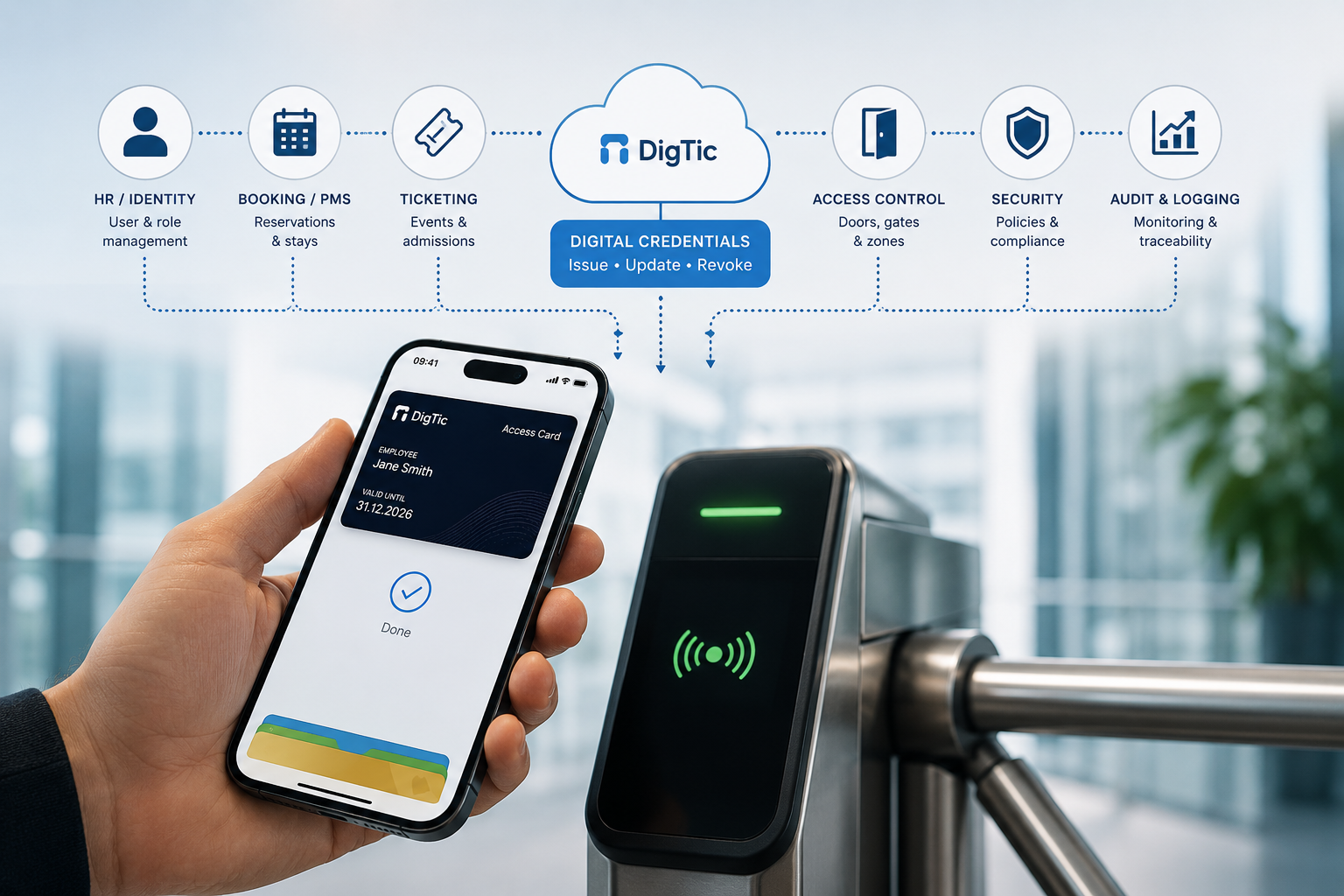
Many organisations have already digitalised parts of the customer journey, but access is often still fragmented. An employee is approved in the HR system but waits for a physical badge. A hotel guest checks in online but still needs a plastic key card. A contractor has been authorised but is stopped at the entrance because access rights have not been synchronised.
The challenge is rarely the mobile wallet itself. The challenge is connecting it to the existing infrastructure.
Wallet is not the system
Apple Wallet and Google Wallet should be seen as delivery channels, not access control systems. The real business logic already exists elsewhere:
- Identity management
- HR systems
- Booking or reservation platforms
- Hotel PMS
- Event platforms
- Access control systems
- IAM solutions
A wallet credential is simply the digital representation of an access right. If those systems are not connected, replacing plastic with a mobile phone only moves the friction elsewhere.
The integration layer matters
A successful wallet deployment depends on one thing: reliable integration. When a user is created, updated or removed, the corresponding credential must follow automatically. That means:
- Issue credentials automatically
- Update permissions instantly
- Revoke access immediately when required
- Keep every connected system synchronised
For large organisations this is often more important than the wallet itself.
Why many projects fail
Many wallet projects start with the user interface:
- A digital pass is designed.
- A reader is configured.
- A mobile app is demonstrated.
Only afterwards do organisations discover the difficult questions:
- Which system owns the access rights?
- Who decides when access expires?
- What happens when an employee changes department?
- How are temporary contractors handled?
- How are revoked credentials propagated?
Without clear answers, the pilot may work, but production rarely does.
Think infrastructure, not features
The organisations that succeed usually treat digital credentials as infrastructure. Instead of building separate solutions for employees, visitors, contractors, hotels and events, they create one platform that distributes digital rights across multiple systems. The same architecture can then support:
- Employee access
- Visitor management
- Hotel room keys
- Event tickets
- Temporary contractors
- Mobility and transport services
Different use cases. One infrastructure.
Security follows the credential lifecycle
Security is not only about encryption or secure APIs. The real challenge is controlling the entire lifecycle of a credential. A secure platform should answer questions like:
- Who is allowed to issue credentials?
- Which systems are trusted?
- How is access revoked?
- What happens if a phone is lost?
- How are audit trails maintained?
When those processes are standardised, organisations gain both stronger security and simpler operations.
Start with one workflow
Large transformations rarely begin with replacing every access system. A better approach is choosing one clearly defined workflow and proving the entire lifecycle:
- Issue
- Deliver
- Validate
- Update
- Revoke
Once that process works reliably, expanding to additional buildings, departments or business areas becomes significantly easier.
Digital rights, not digital cards
The long-term value is not replacing plastic cards. It is creating a platform where digital rights can be issued, updated and revoked across multiple systems without manual administration. That is where mobile wallets become part of the organisation's infrastructure rather than simply another user interface.
At DigTic, we help organisations integrate Apple Wallet and Google Wallet with existing access control, ticketing and identity systems — allowing digital credentials to become part of a scalable, secure and future-ready platform.
Want to integrate wallet credentials with your existing access control?
Talk to us